The average cost of a ransomware attack reached $5.75 million in 2025, up 17% from 2024. Global incidents surged 34% year over year to 4,701 attacks in just 9 months. Manufacturing became the most targeted sector with a 61% jump in attacks.
Our research team analyzed data from IBM Security and Sophos along with multiple threat intelligence reports covering the first three quarters of 2025. We focused on verified financial impacts to provide SMBs with actionable intelligence for protecting their operations. This analysis examines actual costs rather than theoretical projections.
What You Will Learn
- Total Cost Breakdown for 2025: Complete financial analysis including ransom payments and hidden recovery expenses
- Industry-Specific Attack Rates: Targeting patterns across major sectors with average cost data
- Primary Attack Vectors: How ransomware infiltrates networks and compromises systems
- Recovery Time and Success Rates: Actual restoration timelines and backup effectiveness data
- Prevention Strategy ROI: Cost-effective security measures that reduce ransomware risk for SMBs
Total Cost Breakdown for 2025
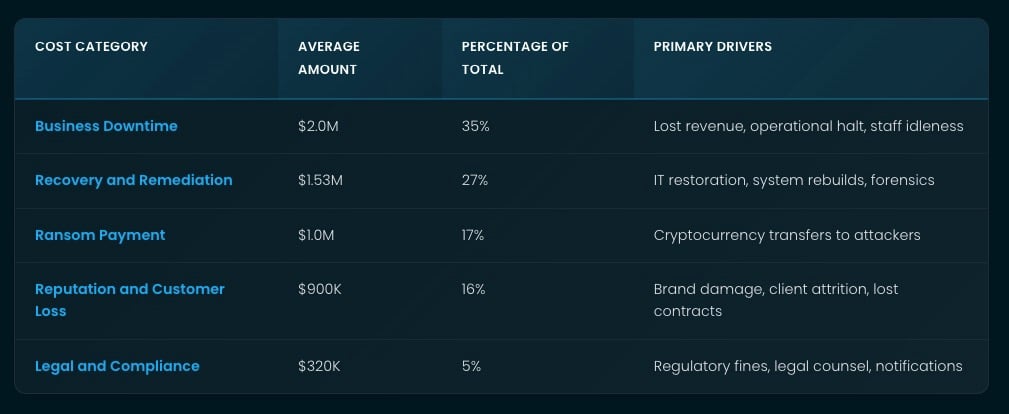
Ransomware attacks impose costs far beyond the ransom demand itself. Our analysis of 2025 data reveals the complete economic picture, as shown in the table below.
| Cost Category | Average Amount | Percentage of Total | Primary Drivers |
|---|---|---|---|
| Business Downtime | $2.0M | 35% | Lost revenue, operational halt, staff idleness |
| Recovery and Remediation | $1.53M | 27% | IT restoration, system rebuilds, forensics |
| Ransom Payment | $1.0M | 17% | Cryptocurrency transfers to attackers |
| Reputation and Customer Loss | $900K | 16% | Brand damage, client attrition, lost contracts |
| Legal and Compliance | $320K | 5% | Regulatory fines, legal counsel, notifications |
Key Insights
- Downtime costs exceed ransom payments by 100% and the average disruption lasts 24 days before full operational restoration.
- Organizations that maintained offline backups reduced recovery costs by 44% compared to those paying ransom demands.
Industry-Specific Attack Rates and Financial Impact
Cybercriminals target specific industries based on their vulnerability to operational disruption. Manufacturing replaced healthcare as the most attacked sector in 2025. Attack frequency varies dramatically across industries. In our analysis below, manufacturing organizations faced the highest attack rates due to legacy systems.
| Industry | Attack Rate % of Sector | Average Total Cost | Median Ransom Demand | Payment Rate |
|---|---|---|---|---|
| Manufacturing | 61% | $5.8M | $3.35M | 52% |
| Healthcare | 54% | $4.5M | $3.49M | 58% |
| Finance and Insurance | 48% | $6.2M | $3.91M | 41% |
| Retail and Hospitality | 43% | $5.1M | $5.7M | 45% |
| State and Local Government | 34% | $2.83M | $1.58M | 38% |
Key Insights
- Manufacturing attacks surged 61% year over year as cybercriminals exploit industrial control systems with inadequate security patches.
- Finance sector organizations experienced the highest total costs at $6.2 million due to regulatory penalties but maintained the lowest payment rates at 41%.
Primary Attack Vectors and Entry Points
Understanding how ransomware infiltrates networks is essential for developing effective defenses. The majority of successful attacks exploit preventable security gaps. Our data indicates that three attack vectors account for 74% of all successful ransomware incidents.
| Attack Vector | Percentage of Attacks | Average Dwell Time | Detection Difficulty | Prevention Cost |
|---|---|---|---|---|
| Exploited Vulnerabilities | 32% | 21 days | Moderate | $15K-$50K annually |
| Compromised Credentials | 23% | 17 days | High | $8K-$25K annually |
| Phishing and Social Engineering | 19% | 14 days | Low | $5K-$15K annually |
| RDP Compromise | 15% | 28 days | Moderate | $3K-$10K annually |
| Software Vulnerabilities | 11% | 35 days | High | $20K-$40K annually |
Key Insights
- Exploited vulnerabilities remained the leading cause of ransomware for the third consecutive year with most attacks targeting unpatched systems over 6 months old.
- Organizations implementing multi-factor authentication reduced credential-based attacks by 82%, achieving the highest ROI from a security investment of under $10K annually.
Recovery Timelines and Success Rates
The speed and completeness of recovery directly impact total attack costs. Organizations with tested incident response plans recovered significantly faster than those without formal procedures. The table below shows actual recovery outcomes from surveyed organizations.
| Recovery Metric | 2025 Data | 2024 Comparison | Best Practice Impact |
|---|---|---|---|
| Organizations Achieving Full Recovery | 97% | 92% | +5% |
| Recovery Within 1 Week | 53% | 35% | +18% |
| Average Recovery Time (Days) | 12 days | 24 days | -50% |
| Organizations Using Backups Successfully | 87% | 76% | +11% |
| Average Recovery Cost (No Ransom) | $1.53M | $2.73M | -44% |
Key Insights
- Organizations that tested their backup systems quarterly recovered 3x faster than those that never validated their restoration processes.
- Only 49% of attacked organizations paid ransoms in 2025, down from 56% in 2024, as backup reliability improved across all sectors.
Prevention Investment vs. Attack Costs
Even basic security measures deliver substantial ROI compared to the costs of attack recovery. Our analysis below demonstrates the cost-effectiveness of standard security investments.
| Security Measure | Annual Investment | Risk Reduction | Attacks Prevented Per $100K Invested | Break-Even After |
|---|---|---|---|---|
| Offline Backup Systems | $15K-$35K | 68% | 11.2 | 1st prevented attack |
| Multi-Factor Authentication | $8K-$18K | 82% | 26.4 | 1st prevented attack |
| Security Awareness Training | $5K-$12K | 54% | 29.7 | 1st prevented attack |
| Vulnerability Scanning and Patching | $25K-$45K | 71% | 8.9 | 1st prevented attack |
| Managed Detection and Response | $45K-$95K | 89% | 3.7 | 1st prevented attack |
Key Insights
- All five core security measures pay for themselves after preventing a single ransomware incident with MFA delivering the highest protection per dollar invested.
- Small businesses spending $50K annually on combined security measures reduced their ransomware risk by 91% compared to organizations with no formal security program.
Request a PDF Copy of This Report
Contact Total Assure today to request a PDF copy of this report to share with your leadership team and use as a framework for evaluating your organization's ransomware readiness. Total Assure helps SMBs implement federal-grade security at accessible price points, ensuring your business stays protected without breaking your budget.
Sources
- IBM Security. "Cost of a Data Breach Report 2025."
- Sophos. "The State of Ransomware 2025."
- Resilience. "Midyear 2025 Cyber Risk Report."
- DeepStrike. "Ransomware Statistics 2025: Global Trends, Costs & Industry Impact."
- PurpleSec. "The Average Cost of Ransomware Attacks (Updated 2025)."
- Mimecast. "Ransomware Statistics 2025: Attack Rates and Costs."
- Verizon. "2025 Data Breach Investigations Report."