Phishing attacks accounted for an average breach cost of $4.88 million in 2024. Organizations worldwide reported more than 1 million distinct phishing campaigns in the first quarter of 2025 alone. The financial impact of these attacks extends far beyond immediate monetary loss, creating cascading effects.
Our research draws from verified breach reports published by leading cybersecurity firms and government agencies. We analyzed cost breakdowns spanning detection, remediation, and recovery. The data reveals industry-specific targeting patterns and emerging attack techniques that help organizations evaluate their security posture.
What You Will Learn
- Phishing Attack Costs in 2025: Global average breach costs and how they've changed over time
- Cost Breakdown by Company Size: How organizational scale affects financial impact from phishing breaches
- Industry-Specific Targeting and Costs: Which sectors face the highest phishing exposure
- Detection and Response Time Impact on Costs: How quickly identifying breaches affects total financial damage
- Phishing Attack Methods and Associated Costs: Financial consequences of different attack vectors like Business Email Compromise
Phishing Attack Costs in 2025
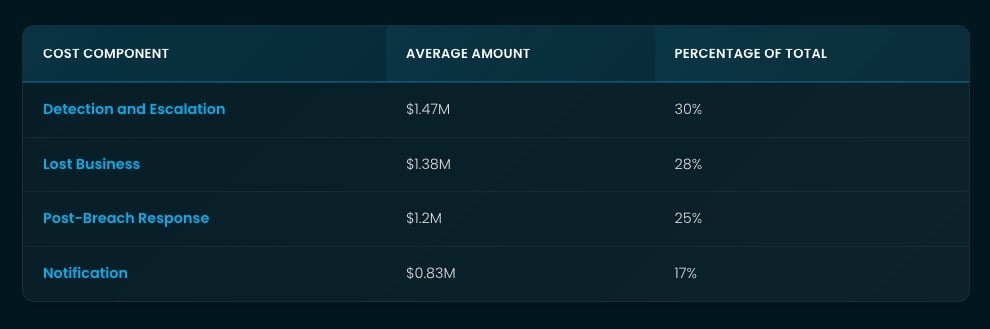
The financial damage from phishing manifests through direct theft, operational disruption, and long-term reputational harm. Organizations report an average loss of $17,700 per minute during active phishing incidents. The table below illustrates the complete cost structure broken down by primary expense categories.
| Cost Component | Average Amount | Percentage of Total |
|---|---|---|
| Detection and Escalation | $1.47M | 30% |
| Lost Business | $1.38M | 28% |
| Post-Breach Response | $1.2M | 25% |
| Notification | $0.83M | 17% |
Key Insights:
- Detection and escalation costs cover forensic analysis conducted by investigation teams during the initial crisis management phase. These activities occur before the full scope of the breach is understood.
- Lost business costs stem from customer churn following breach disclosure with 32% of phishing victims reporting measurable trust erosion that directly impacted revenue.
Cost Breakdown by Company Size
Phishing attacks impose disproportionate financial consequences on organizations of different scales. Enterprise budgets can absorb certain breach costs through dedicated security teams and cyber insurance, while smaller businesses often face existential threats from the same incident. Data on cost variations across organizational sizes are shown in the table below.
| Organization Size | Average Breach Cost | Cost per Record | Average Recovery Time |
|---|---|---|---|
| Small (Under 500) | $120,000 - $1.24M | $165 | 67 days |
| Medium (500-5,000) | $2.4 million | $148 | 73 days |
| Large (5,000+) | $5.3 million | $156 | 82 days |
| Enterprise (10,000+) | $8.2 million | $169 | 94 days |
Key Insights:
- Small businesses experience 60% closure rates within 6 months of a major phishing breach, reflecting limited reserves to cover recovery costs.
- Large enterprises face higher absolute costs but lower per-record expenses due to economies of scale in security operations and breach response capabilities.
Industry-Specific Targeting and Costs
Threat actors focus phishing campaigns on sectors that handle valuable data or operate under regulatory constraints. Financial services organizations experience the highest attack volumes, alongside the healthcare and manufacturing sectors. These industries also incur the highest breach-related expenses. Our analysis of industry-specific phishing costs follows in the data below.
| Industry | Average Breach Cost | Phishing as % of Breaches | Avg Records Exposed |
|---|---|---|---|
| Healthcare | $10.93 million | 32% | 384,000 |
| Financial Services | $6.8 million | 36% | 267,000 |
| Professional Services | $5.7 million | 28% | 156,000 |
| Manufacturing | $4.73 million | 32% | 201,000 |
| Retail | $3.48 million | 24% | 312,000 |
Key Insights:
- Healthcare breach costs exceed those in other industries by 60% due to HIPAA regulatory penalties and the elevated remediation complexity across interconnected clinical systems.
- Financial services firms experience the highest volume of phishing attacks, accounting for 51.6% of detected attacks in certain regions, and they require proportionally larger security investments.
Detection and Response Time Impact on Costs
The speed at which phishing breaches are identified directly correlates with financial outcomes. Organizations that detect compromise within 200 days save an average of $1.2 million compared to those that exceed this threshold. The relationship between the response timeline and financial impact is shown in the data below.
| Detection Timeline | Average Total Cost | Cost Difference vs. Baseline | Typical Damage Scope |
|---|---|---|---|
| Under 100 days | $3.93 million | $-950,000 | Limited lateral movement |
| 100-200 days | $4.88 million | Baseline | Moderate data exfiltration |
| 200-300 days | $6.12 million | $+1,240,000 | Multiple system compromise |
| Over 300 days | $7.34 million | $+2,460,000 | Enterprise-wide breach |
Key Insights:
- Organizations implementing automated phishing simulation programs reduced the average detection time by 77 days by improving employees' recognition of social engineering tactics.
- Companies with incident response retainers activated within 1 hour of breach discovery contained attacks 63% faster than those assembling response teams after compromise confirmation.
Phishing Attack Methods and Associated Costs
Different phishing techniques generate distinct cost profiles based on attack complexity and damage potential. Business Email Compromise attacks produce the highest individual losses, whereas mass credential-harvesting campaigns accumulate costs through volume. The cost analysis of the different attack vectors is presented in the table below.
| Attack Method | Average Incident Cost | Detection Rate | Success Rate vs. Untrained Users |
|---|---|---|---|
| Business Email Compromise | $160,000 | 73% | 18% |
| Credential Harvesting | $4.88 million | 54% | 33% |
| Malware Distribution | $5.12 million | 67% | 11% |
| QR Code Phishing | $97,000 | 41% | 24% |
| AI-Generated Attacks | $4.91 million | 46% | 29% |
Key Insights:
- QR code phishing attacks increased 331% year-over-year, but incurred lower per-attack costs due to limited automation capabilities relative to traditional phishing infrastructure.
- Organizations that implemented security awareness training reduced phishing simulation failure rates from 33% to 3.2% within 12 months, corresponding to an 86% reduction in successful real-world attacks.
Ready to strengthen your security posture against evolving phishing threats? Request a PDF copy of this report for comprehensive data analysis and recommended defense strategies tailored to your organization's risk profile.
Sources
- IBM Security. "Cost of a Data Breach Report 2025."
- DeepStrike. "Phishing Statistics 2025: AI-Driven Attacks, Costs & Trends."
- Hoxhunt. "Phishing Trends Report (Updated for 2025)."
- Bright Defense. "200+ Phishing Statistics (October 2025)."
- Guardz. "33 Phishing Statistics in 2025 Every MSP Should Know About."